

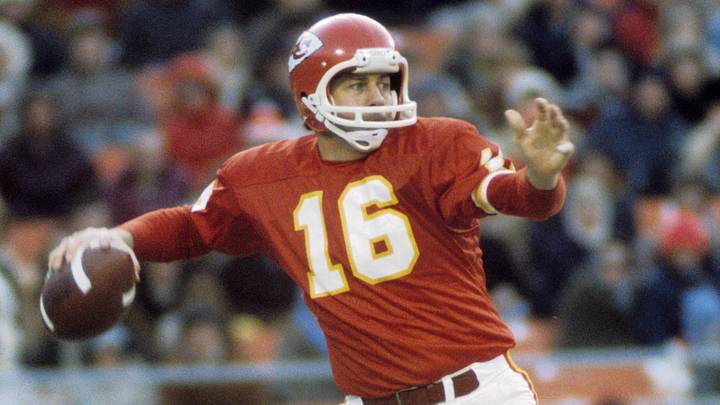
The history of the Kansas City Chiefs can largely be characterized by the quarterback play over the 60-plus years this franchise has stood. Much of the Chiefs' glory at the QB position is few and far between, but there are some who truly transcended the game of football.
Playing the hardest position in sports is not for the weak-minded, as for a QB, the game is as much mental as it is physical. Not everybody can hold up to the high standards of being the face of a franchise and having to take the brunt of scrutiny when the team is not performing well. But when you find a good one, you know it right away. And with a couple of these guys, you knew greatness was happening right in front of you.
In KC Kingdom's second edition of "Chiefs All-Time Mount Rushmore", I take a closer look at four signal callers that truly changed the direction of this organization for the better.
There haven't been a lot of great QB's in Chiefs history, but Len Dawson set the stage for Patrick Mahomes to carry the torch
Lenny the Cool: Len Dawson
Up until about a decade ago, Len Dawson was the only true elite quarterback of his era that the Chiefs could really hang their hat on. And man was he good. After his first five seasons playing for the Pittsburgh Steelers and Cleveland Browns, Dawson came to the then Dallas Texans, pairing up with head coach Hank Stram, whereupon the pair ran roughshod over the entire AFL in their first season together in 1962.
The Texans went 11-3 behind the Dawson-led number one scoring offense in the league. For the season, Dawson completed 61% of his passes for 2,759 yards and 29 touchdowns, passing numbers unheard of at the time. Dallas won the AFL championship that year, somewhat prompting owner Lamar Hunt to relocate to Kansas City and rebrand as the Chiefs.
From that point on, all Dawson did was keep growing his numbers at an astounding rate, and led the Chiefs to their first Super Bowl appearance in 1966, where they ended up getting trounced by Green Bay, but not before going 11-2-1 in the regular season. He then led the Chiefs back to the big game in 1969, where the Chiefs managed to win Super Bowl IV over Minnesota 23-7.
For over 50 years, Dawson held the Chiefs' all-time record for anything that had to do with passing, whether it be yards (28,507), TDs (237), wins (93), fourth-quarter comebacks (15), and more. He still remains the Chiefs' leader in TD percentage at 6.4%. Dawson never got rattled and always remained this charismatic but genuine guy who his teammates could relate to, and who a city could get behind. Len Dawson will forever live on as the Chiefs' first and foremost Hall of Fame quarterback.
The Game Manager: Trent Green
In truth, I'm not sure what moniker I wanted to use for Trent Green. It's obvious how brutally horrendous the Chiefs' history at quarterback must have been if it wasn't for over 30 years and in a new century since Len Dawson that another one made the Mount Rushmore. But if we're putting four guys on this list as the series name suggests, Green deserves a spot.
The starting QB for the whole of the five-year Dick Vermeil-led Chiefs was a constant and reliable game-by-game manager. He had some talent, yes, but he was a leader and a guy who united an early-2000s Chiefs team to some of the better years that this franchise had seen in quite some time.
In his 80 starts in Kansas City, Green accumulated over 20,000 passing yards, 111 TDs, and a 44-36 record. He also made two Pro-Bowls in 2003-05. There's no doubt he was boosted by some of the best offensive talent of that era of football in RB Priest Holmes, TE Tony Gonzalez, return specialist Dante Hall, and an incredibly stout offensive line.
But Green, along with Vermeil, gave the Chiefs a half-decade stretch where they won double-digit games twice, including a 13-win season in 2003 that saw KC win the AFC West and make the playoffs for the first time since 1997. Green is firmly deserving of a spot on this list and is remembered fondly by Chiefs fans today because they knew what he was one of the good ones.
The Professional: Alex Smith
Perhaps the first thing people think of when they hear the name Alex Smith is the gruesome bouts of leg injuries the quarterback had to suffer in the back-end of his career in Washington, and how he came out on the other side winning the NFL's Comeback Player of the Year award in 2020. However, when Chiefs fans think of Smith, all they can do is smile.
Much of that has to do with what he did to help the last guy on this list prepare to play in the NFL. But I think more of why we should revere Smith is how he, along with the help of head coach Andy Reid, brought the Chiefs back up from the depths of football purgatory and placed the organization firmly back into playoff contention year in and year out.
Smith's career began in San Francisco, but he took a starting job with the Chiefs in 2013, Reid's first year, and held that role for five seasons. Smith's statistics were not mindblowing, but they were also nothing to sneeze at. He garnered a total of over 17,600 passing yards and 102 touchdowns on a very low 33 interceptions. What's more impressive is the immediate winning impact his presence had on the Chiefs' building and the belief he instilled in the guys in the locker room.
In his career, the Chiefs went 50-26, made the playoffs three years in a row from 2015-17, and won the team's first playoff game since the 1993 season. Smith was the ultimate teammate and a guy who put others in front of himself, as any good quarterback does. How he managed to completely set aside his ego and own ambition to make way for the Chiefs' first-round draft pick in 2017 was something truly shocking and honorable. And not only that, but to be a mentor and the ultimate sounding board in the midst of knowing his job was not his anymore, whether he liked it or not.
The GOAT: Patrick Mahomes
I get it. Mahomes hasn't played long enough to be considered the greatest of all time. That title remains Tom Brady's, and rightfully so. Brady's career accomplishments are almost unbelievable, and for so long, many felt like he could never be touched. But when Mahomes showed up and became God in cleats, Brady's goat case started to shrink little by little.
Mahomes sat in his first full season learning everything he could behind Smith, and took the reins in 2018, never looking back. That year, Mahomes threw for over 5,000 yards, 50 touchdowns, and had a 113.8 passer rating. The Chiefs' offense, along with the elite weapons of Travis Kelce and Tyreek Hill, became unstoppable, averaging over 35 points per game. Mahomes easily made first-team All-Pro and won both the MVP award and Offensive Player of the Year.
That year, with Reid still at the helm, began a seven-year stretch of the Chiefs making consecutive AFC championship games, whereupon they made five Super Bowls and won three of them, including the NFL's first back-to-back in 20 years. It cemented the Chiefs as one of the very few dynasties in NFL history and vaulted Mahomes up the all-time QB rankings to, in many eyes, top-three of all-time. He holds the record for just about every major passing category, not just in Chiefs history but in league history as the youngest to accomplish said feat.
Mahomes won another MVP award and made his second first-team All-Pro team in 2022, setting the NFL record for most total yards in a single season at 5,608, adding another 45 TDs. Mahomes is everything you want in a quarterback, with seriously no clear weakness in his game. He has a rocket of an arm, can pass from any angle by contorting his body, has the movement skills both in and out of the pocket, can process both pre-and post-snap with the best of them, and is the definition of a leader of men, who excels in the community and is a role model to anyone who looks up to him.
As Patrick Mahomes enters his age-30 season, many in the football realm have become numb to his greatness, but after missing the playoffs in 2025 and coming off a torn ACL quicker than most humans ever have, there is clearly added motivation for one of the great sports competitors of our time to prove once again that the Chiefs still own the National Football League.
 Add us as a preferred source on Google