

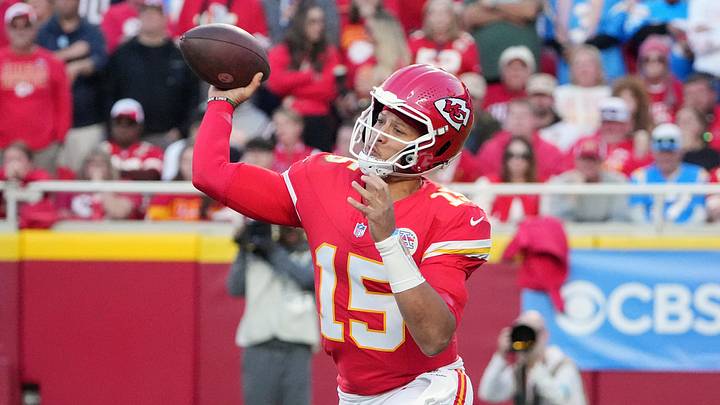
The Kansas City Chiefs are 5-0, and Patrick Mahomes just won a game without throwing a touchdown pass. A few years ago, that might have sounded like a problem. On Sunday, it barely slowed Kansas City down.
The Chiefs defeated the Los Angeles Chargers 22-6, with Kenneth Walker III rushing for 106 yards and two touchdowns. Mahomes completed 23 of his 30 passes for 272 yards, although an interception near the goal line kept his afternoon from looking quite as impressive.
And that's where things get interesting.
Kansas City has finally built an offense that doesn't require Mahomes to do everything. The uncomfortable part? The Chiefs might actually be better when they stop asking him to.
Patrick Mahomes no longer has to carry the Chiefs' offense
Mahomes entered Sunday with nine touchdown passes through four games. He'd thrown at least two in every contest, looking much closer to the quarterback who once made 300-yard afternoons seem routine.
Against Los Angeles, he didn't need anything close to that.
Walker ripped off a 33-yard touchdown run in the first quarter and added another score from two yards out before halftime. By then, Kansas City had established control of the game without Mahomes throwing a single touchdown.
That wasn't how the Chiefs operated during some of their recent championship runs.
There were stretches when the offense depended on Mahomes escaping pressure, extending plays, and somehow finding Travis Kelce or another receiver after everything had broken down.
Entertaining? Absolutely.
A sustainable way to operate for an entire season? That's another question.
Walker has changed the equation. His ability to turn an ordinary rushing attempt into a substantial gain gives defenses something else to worry about.
Mahomes doesn't have to manufacture every explosive play anymore.
Chiefs still have one issue Patrick Mahomes must correct
Sunday wasn't a flawless performance from the two-time MVP.
Kansas City had an opportunity to capitalize on a Justin Herbert interception that gave the Chiefs excellent field position. The offense reached the Chargers' two-yard line before Mahomes made an uncharacteristic mistake.
Rather than throw the ball away under pressure on third down, he attempted to salvage the play and was intercepted.
That's the kind of decision Kansas City can survive against an opponent that managed only six points. It becomes considerably more expensive against a team capable of matching the Chiefs offensively.
And it's worth remembering that Kansas City scored only 22 points despite spending much of the afternoon in control.
The running game is providing answers. The defense is doing its job. But the Chiefs still need to finish drives, particularly when Mahomes has opportunities to put games out of reach.
Kansas City's new offensive identity could change everything
Here's something worth considering.
Walker entered Sunday's game averaging more than six yards per carry. He followed that up with another 100-yard performance, giving Kansas City a rushing threat that opponents simply cannot dismiss.
For Mahomes, that's an enormous advantage.
Defenses can't devote every resource to stopping the passing game when Walker is capable of breaking off a touchdown run. And when opponents begin crowding the line of scrimmage, Mahomes has the arm talent to punish them.
That's a difficult combination to defend.
The Chiefs are undefeated, and Mahomes remains one of the NFL's most dangerous quarterbacks. Nobody is suggesting Kansas City should take the football out of his hands.
But Sunday's victory showed something that should concern the rest of the AFC.
Kansas City doesn't need a spectacular Mahomes performance to win comfortably anymore. Sometimes, a sub-300 passing yard, no touchdown performance are enough.
For a franchise that spent years depending on its quarterback to produce something extraordinary, that might be the most encouraging development of all.
 Add us as a preferred source on Google