

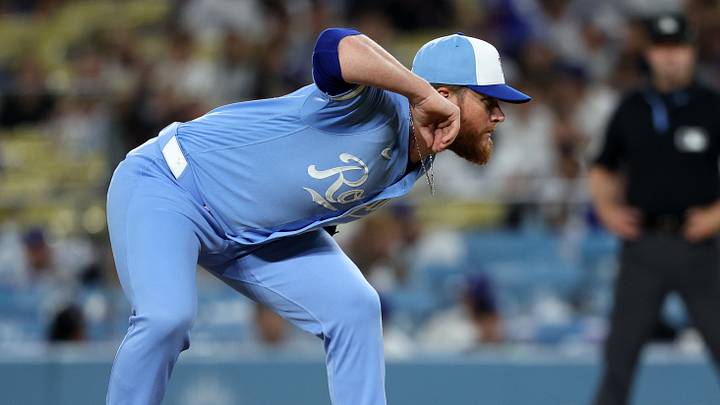
There is no reason why Craig Kimbrel should currently be on the Kansas City Royals' active roster. Kimbrel should not be pitching meaningful innings for a team that, in less than three months, will not be rostering him. Given the Royals' current situation and Kimbrel's age, such a signing is inconsistent with what the Royals' priorities should be in finishing out a nightmare season: Development and evaluation.
There are many teams in Major League Baseball that have a reasonable need for relievers entering the final stretch of 2026. The Royals are among them, but on the other hand, they are currently one of the worst teams in baseball. They are in need of relievers, but they will not be playing in the postseason.
That hole, sizable enough to effectively doom the Royals to irrelevance despite not being mathematically eliminated from contention, was dug well in advance of Kimbrel's signing. This means that Kimbrel, despite fitting the Royals' need for bullpen help, is not in any way the type of player the Royals should have targeted to fill it.
Where did it go wrong for the Royals in 2026?
2026 has been a year to forget, rife with frustration and significant underachievement, for the Royals. The defining moment for this year's squad, of which there are many candidates, may well have occurred in only their second game of the season; then-closer Carlos Estévez entered the ninth with a 2-0 lead over the Atlanta Braves and surrendered six runs that culminated in a walk-off grand slam and a 6-2 loss.
There is a compelling argument to be made that this particular game, despite it having taken place at the very beginning, serves as the perfect encapsulation of things to come for the Royals. Their offense failed to generate sufficient run support that day, and their bullpen failed to close out the game. As the season has progressed, the latter problem has repeated itself like a broken record. Much has changed with the Royals since late March, notably with the makeup of their bullpen and starting rotation due to a wave of injuries. Much more, however, has paralleled that dubious event, with late losses and multiple blown saves driving the Royals to the bottom.
This is why the Royals, who started the season with aspirations to contend within a weak American League (AL) Central, instead find themselves deep in the AL's cellar. Barring a miraculous resurgence, they will end 2026 with their first losing record and last-place divisional finish in three years. They have not yet won their 62nd game, with 100 losses remaining within the realm of possibility. Extensive injuries to their pitching corps and depth options, despite being of notable detriment to the team's performance, cannot serve as the all-encompassing justification used by the front office in addressing the team's failure to meet initial expectations.
What have the Royals done to fix their bullpen problems?
Since the end of July, the Royals have been busy seeking pitchers that could be useful to the major-league squad in the short and long-term. They conducted three trades at the deadline, sending outfielder Lane Thomas and left-hander Bailey Falter to the Braves, left-hander Kris Bubic to the Los Angeles Dodgers, and right-handed relief prospect Manuel Colón to the Philadelphia Phillies; the Royals' collective return largely consisted of MLB-ready pitching prospects, with Lucas Braun, Nolan Hoffmann, and reliever Carlos Durán serving as options for 2027 and beyond.
Adding Nate Pearson, Luke Little, and Connor Thomas to the organization also provided them with controllable relief depth, with Pearson quickly becoming a serviceable arm and giving the Royals 8 2/3 innings of 1.04 ERA ball as of publication; the recent signing of left-hander Tony Gonsolin to a two-year major-league contract provides them with a rotation arm for 2027. All of these additions are justifiable, as they were not made with potential 2026 contributions in mind.
Kimbrel is an unjustifiable anomaly for the 2026 Royals
Kimbrel, as well as right-hander Randy Dobnak, are the only recent additions that do not fit on paper as the Royals shift to evaluating their future with the remainder of 2026. Dobnak, however, has been nothing short of a revelation for the Royals since joining the team at the beginning of July, earning that month's organizational Pitcher of the Month award and currently sporting a sterling 1.73 ERA over 8 games (6 starts) and 41 2/3 innings.
As such, it remains possible that Dobnak, who will be 32 in the 2027 campaign, could wind up being re-signed and force himself into Kansas City's rotation plans for next year, given both his dominant performance and the Royals' current lack of starting depth.
Kimbrel, on the other hand, does not have a meaningful role with the Royals. Kimbrel, a 38-year-old reliever who was once among baseball's upper echelon of closers and has paled considerably in comparison to his peak, has been a journeyman arm for much of this decade and has already been jettisoned by two different organizations in 2026.
Coincidentally, on June 25, Kimbrel spoiled the Tampa Bay Rays' perfect-game bid against the Royals when tasked with the ninth inning, by way of issuing a walk to outfielder Starling Marte and subsequently spoiling the potential no-hitter by surrendering a two-run home run to catcher Carter Jensen.
Signing a player like Kimbrel, who will not play any role in the Royals' future and only helps the team in a season that is already beyond saving, is not a rational move made by organizations outside of contention such as the Royals. Those organizations are best served evaluating young or controllable talent for the value they may have during the team's internal window of contention. It is contending teams that tend to target this type of player, since development is of little concern and the player (i.e., Kimbrel) could assist in winning games.
What makes no sense, in this case, is that the Royals believe that Kimbrel could help their young pitchers in an already ineffective bullpen by taking a 26-man roster spot and pitching actual innings instead of allowing the prospects to pitch the innings and get better through working with the team's coaching staff. Asked about Kimbrel's prospective role with the Royals, manager Matt Quatraro responded to MLB.com's Anne Rogers and Jack Janes with the sentiment that Kimbrel's presence was deemed necessary in order to win games.
""He's going to pitch in different roles," said manager Matt Quatraro of Kimbrel's spot in the bullpen. "Could be early, could be late, depending on who's available. But his presence, his accountability, all the things that have made him great over the years to help rub off on some of the young guys as we continue to build.""Anne Rogers & Jack Janes
Wins in 2026 are no longer of significance to the Royals. As such, Kimbrel is of no use to the Royals. The decision to sign a 38-year-old journeyman who will be collecting a pension in the near future, instead of opting to develop and evaluate pitching through experience in a lost season, is incomprehensible. It is nonsensical and so far off from the Royals' priorities, in fact, that the decision to sign him is an act that one may count as organizational malpractice. It contradicts the goal of building the team for 2027 by denying one of the prospects, namely Braun, Durán, Little, and even the surging outfield prospect Gavin Cross, opportunities for much-needed experience in the majors.
Among the multitude of problems that have impacted the Royals this season, setting clear and realistic goals, and especially operating in accordance with those goals, may have become an issue yet again with their front office. It was an issue with Dayton Moore, the former GM & President of Baseball Operations, one that led to his firing in 2022. It is too early, despite the furor that 2026 has brought among the fanbase, to say whether his long-time protégé J.J. Picollo will follow in Moore's footsteps.
However, in laying the groundwork for future seasons, it is imperative that Picollo and the front office act in accordance with the Royals' sustained on-the-field performance and make transactions that are reflective of said performance, rather than choosing to sign players who are of no use to the team's present and future.
The reasonable approach makes a baseball team look competent and consistent. The latter approach, on the other hand, is laden with players like Jordan Lyles, Blaine Boyer, and Onelki García. It is evident that the Royals, throughout their recent history, have not generally shown the reasonable approach, and Craig Kimbrel is yet another reminder of this. One can only hope that this will be a forgettable blip on Picollo's track record, rather than a perpetual stain.
 Add us as a preferred source on Google